
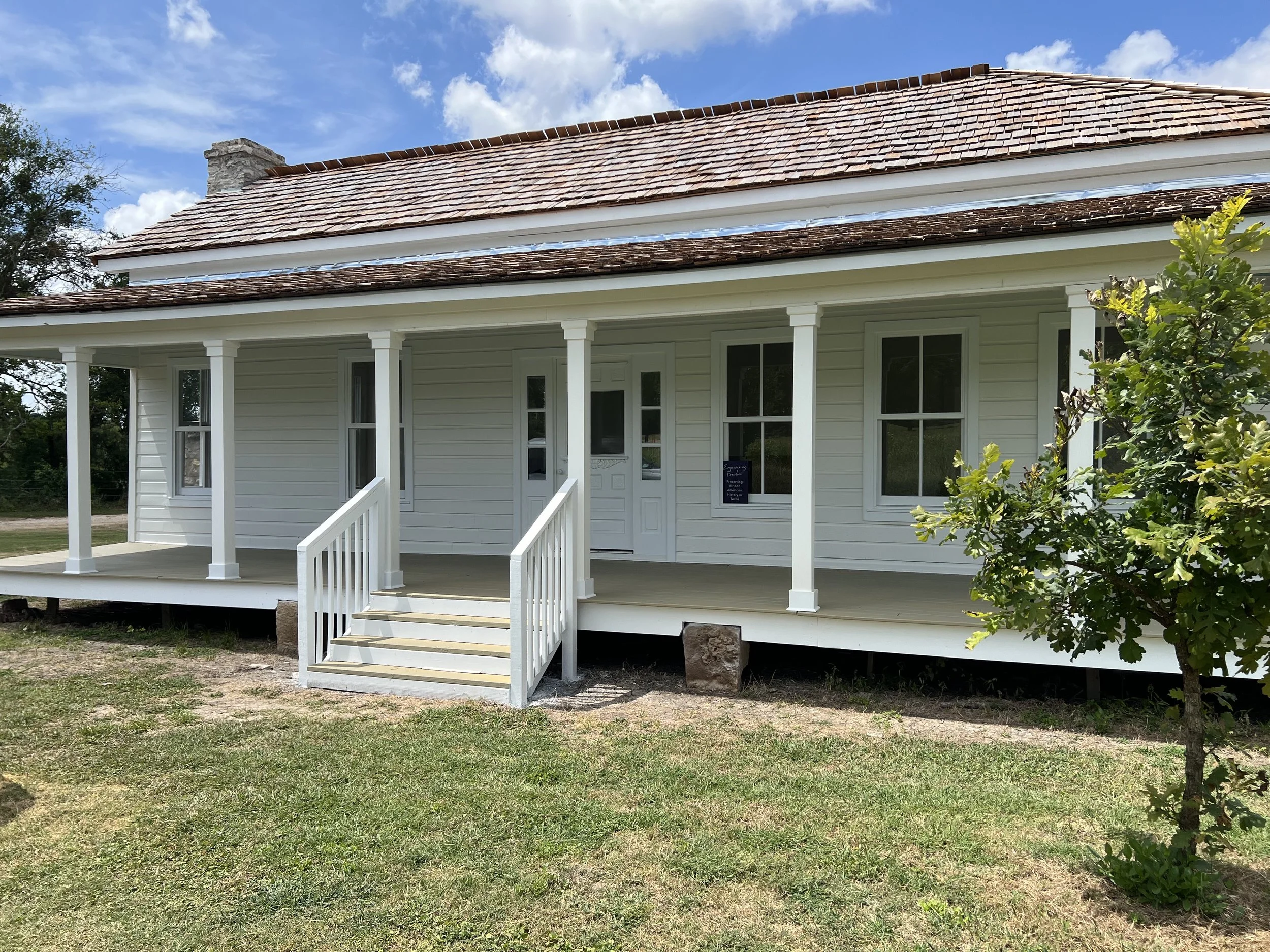
DODSON FARM: iconic Freemen history house restored
The showcase restoration of the Jack and Mary Jane Dodson House is complete, five years after the important African-American history structure was nearly lost to a bulldozer.
Funded in part by a City of Austin Economic Development Department grant and dozens community donations, the project forms the centerpiece of a new 1893 history site celebrating the lives of formerly enslaved Texans in Central Texas after emancipation.
As the final touches are being applied to the restored historic home — likely the last Freedmen farm house still existing in Texas — new exhibits , a barn and other outbuildings are being added to the farmstead located just east of our Sprinkle Corner entrance village.
The Dodson Farm is to eventually be part of a Freedom Trek program that will feature two additional history sites: A structure where formerly enslaved Texans lived before Emancipation and a tenant farmer’s cabin. Plans are being developed for those sites.
The Dodsons came to Austin from a Fayette County plantation and became leaders in the Freedmen’s Movement in Central Texas.
They purchased the house in southwest Travis County in the early 1890s. It was moved to Pioneer Farms to save it from demolition, thanks to a donation from owners Joe Christian and Sandy Laborde.
As finishing touches are completed on exhibits and the site’s grounds, the historic house is now open for visitor tours.
Freedmen families were prominent residents in the area where Pioneer Farms is located, many locating there from large cotton plantations to the north and east on the rich Blackland Prairie. Sprinkle, Texas, a small town once located just southeast of Pioneer Farms, was among nearly two dozen Freedmen’s communities in the Austin area, along with Wheatsville, Clarksville and Rosedale.
Many Freedmen relocated to the Austin area after Emancipation because of the protective presence of the Union Army troops that were stationed in the capital city.
While President Lincoln’s Emancipation Proclamation in 1863 is recognized as the declaration that freed slaves in the United States, Confederate states didn’t recognize the Union decree. So, even after the war ended at Appomattox in April of 1865, Texan slaves weren’t freed until June 19, 1865, when Maj. Gen. Gordon Granger arrived in Galveston and read aloud a Union proclamation that officially ended slavery in Texas.
“The people of Texas are informed that in accordance with a Proclamation from the Executive of the United States, all slaves are free. This involves an absolute equality of rights and rights of property between former masters and slaves, and the connection therefore existing between them becomes that between employer and free laborer . . . ,” states the General Order No. 3 that Granger read.
Much of the history of the Freedmen is not widely known, something the new Freedmen Farm interpretive site seeks to address.
Pioneer Farms currently has 10 interpretive areas: The 1899 Sprinkle Corner entrance village, an 1898 community church, an 1888 Cotton Planter’s Farm, an 1878 Texian Farm, an 1875 Stagecoach Stop, an 1873 Chisholm Trail experience, 1870 German Blockhouse, an 1866 German Emigrant Farm, an 1850s Walnut Creek Greenbelt and an 1844 Tonkawa Encampment.
Donations of any amount to help fund the completion of the historic Dodson Farm grounds are welcomed. You may contribute here. Donors will be recognized in signage at the restored site.